

Teaching AI to Think Like a Trainer


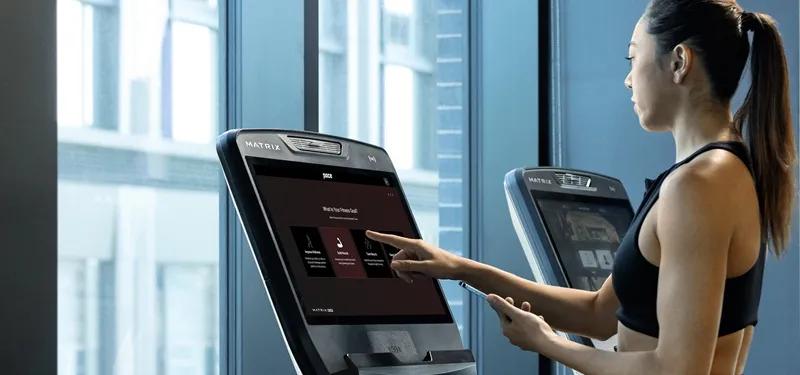
AI is everywhere, but in fitness, generic models alone aren’t enough. To truly enhance the exercise experience, AI needs to understand the nuances of bodies, behaviors, environments and real-world limits.
With Matrix Exercise Learning Intelligence, an AI-powered training solution uniting smart fitness tech with medical-grade body composition data, Matrix set out to prove that the future of personalized fitness isn’t automated workouts.
The next evolution of fitness is grounded in human expertise, experience and insight, encoded and scaled responsibly through proprietary AI.
As Steve Barrett, Director of Global Fitness Programming at Matrix, explains, “This project didn’t start with a blueprint. It grew organically. We were building a machine-learning system from the ground up because we hadn’t done this before, and buying something off the shelf just wouldn’t cut it.”
CHALLENGES OF AI IN FITNESS PERSONALIZATION
The challenge in developing Exercise Learning Intelligence was never purely technological, because the idea itself was born out of unique market needs. Fitness facilities face a widening gap between what members want and what traditional equipment can deliver.
Members want personalized guidance without friction. Operators want to offer exercise personalization without depending on or hiring staff to manage it. Trainers want tools that amplify their expertise and streamlined their workflow, giving them more time to focus building relationships instead of building programs.
To complicate matters, there are many closed digital ecosystems that require facilities to abandon existing equipment and digital products. What’s more, many fitness facilities were eager to deliver holistic wellness experiences, including workouts that reflected real goals, real schedules and real physical conditions.
Matrix saw an opportunity to create something more flexible. Late in 2024, Matrix took the first steps toward developing an adaptive coaching experience that worked with existing equipment while elevating the entire training floor.
CHOOSING A PRECISE PARTNER
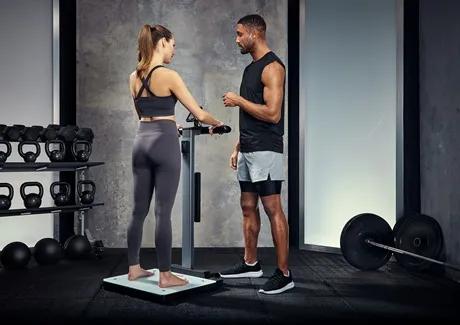
True workout personalization starts with understanding each unique human body inside and out. That requirement led Matrix to partner with seca, a company with almost two centuries of experience in medical-grade measurement and weighing solutions.
seca’s body composition solution delivers a comprehensive snapshot of each individual, built on trusted, medically validated metrics including muscle mass, fat mass, and water levels—reflecting real health and performance profiles.
However, accurate medical insight alone isn’t enough to prescribe an effective workout. The data must be translated into programming that works in busy fitness facilities, with shared equipment and limited time.
That’s where Matrix came in. While seca brought unmatched clinical accuracy to the table, Matrix added its decades of fitness expertise to complete the picture. Together, the partnership created a bridge between precise measurement and practical action, turning data into guidance people could trust and apply immediately.
HOW MATRIX BUILT A FITNESS-SPECIFIC AI MODEL
From the outset, Matrix made a deliberate decision to build a proprietary AI model specifically for fitness. Generic AI systems often rely on scraped or context-free information, producing recommendations that appear credible but fall apart in real-world training environments.
This new model had to be more educated, more insightful and more empathetic — in short, it had to be more human than a generic model could be.
That’s why the developers at Matrix trained our AI differently from the ground up. Matrix built its foundation on established sports science principles, structured programming logic and decades of successful coaching experience.
With enough gentle corrections, the system soon understood not only what to prescribe, but what to avoid. Learning from industry experts, Exercise Learning Intelligence soon came to understand how workouts should be sequenced, how intensity should progress and how recovery factored into long-term success.
This essential foundational work ensured that the AI didn’t just generate workouts with no consideration of the people actually doing them. Thanks to this ground-up approach, Exercise Learning Intelligence could start delivering sound, real-world coaching at scale.
WHY HUMAN EXPERTISE STILL MATTERS IN AI FITNESS COACHING
Despite the promising early outputs, taking the prescribed workouts to the training floor revealed an important truth.
Unfortunately, programs that looked perfect on paper didn’t always work smoothly in practice. Sessions often ran long, with little consideration for the time it took for a user to get from one part of the training floor to another. Equipment use conflicts, a common occurrence in busy fitness facilities, weren’t accounted for either.
Additionally, intensity levels often reflected optimal training theory, which was great for dedicated athletes, but overkill for the average fitness facility member and their goals.
Instead of simplifying the system, the team at Matrix worked tirelessly to refine it. They added guardrails to help Exercise Learning Intelligence function effectively in real-world situations.
Before long, it was able to account for and adjust to busy schedules, limited exercise time, training floor congestion, realistic recovery and much more. Perhaps most importantly, the developers at Matrix adjusted the prescribed programs to reflect how real people actually train, not how bots would train in ideal conditions.
By embedding lived experience and empathetic human insight into the model at the fundamental level, Exercise Learning Intelligence went beyond generic AI systems. The AI at the heart of it became more approachable, more trustworthy and far more effective.
TESTING AI WORKOUTS IN REAL-WORLD GYM ENVIRONMENTS
Of course, Matrix wasn’t satisfied simply validating Exercise Learning Intelligence in theory. The next step for the developers was to test their new AI through months of real workouts in real spaces.
Often, the developers from Matrix took on the AI-generated workout programs themselves, identifying timing gaps, intensity issues and operational friction based on how the exercise experience went for them.
These hours of real-world, heart-pumping workouts led to another round of critical refinement. Manual overrides were introduced to preserve flexibility, letting the end user add the final touch of human insight to correct or perfect the prescribed workout. Progression logic was refined to support consistency rather than idealized training, leading to workout programming that was practical and efficient.
The system even learned to prioritize exercise adherence and user confidence over pushing users to their theoretical limits.
Each round of refinements and enhancements reinforced the principles that Matrix began with — personalized exercise only works when it’s practical, achievable and sustainable for real people in real environments.
THE PERSONALIZED ADAPTIVE COACHING EXPERIENCE (PACE)
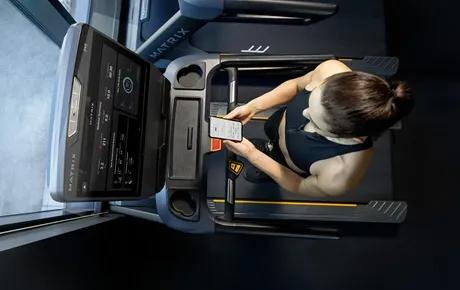
In its more mature form, PACE transforms 24-second body composition scans on seca products into adaptive, goal-based, AI-driven workouts delivered directly through Matrix consoles. Each session feeds new performance data back into the system, allowing programming to evolve with the user as they build confidence and improve their abilities.
The AI within PACE adjusts for available equipment in each individual facility and individual attendance patterns, adapting and adjusting programming in real time. It supports scalable onboarding for users of all kinds, and it virtually eliminates the burden of manual programming.
Trainers also remain central to the experience, now free to focus on strengthening relationships while the AI handles complexity behind the scenes. It even creates more meaningful interaction points between members and staff, a key metric in member satisfaction.
INTELLIGENCE THAT EVOLVES
For Matrix, Exercise Learning Intelligence is a foundation, not a finish line. Its architecture allows for future expansion across wearables, enhanced medical insights and more as each unique facility ecosystem evolves.
As Steve Barrett reflects, “The more we learn about individuals, the more personal this becomes. Personalization isn’t a feature — it’s the future. And this system finally gives us a responsible way to deliver it at scale.”
Exercise Learning Intelligence proves that when AI is shaped by experts, tested in reality and guided by human insight, it doesn’t replace coaching. It elevates the exercise experience for everyone.
